Stylos DISC Emotional Intelligence Career Motivators ECO Stylos Contact Log In
NEW Stylos EIA™

Emotional Intelligence you can measure.

Knowing yourself is the first act of emotional intelligence — and also the bravest.

Stylos EIA™ goes beyond what people say about themselves. It combines self-perception with real performance in emotionally charged situations, to reveal how someone actually knows, manages and expresses emotions — and gives them a concrete plan to grow.

0
Dimensions
0
Competencies
0
Assessment methods
0
Report pages
Stylos Emotional Intelligence report cover
Overall EI
75
Established
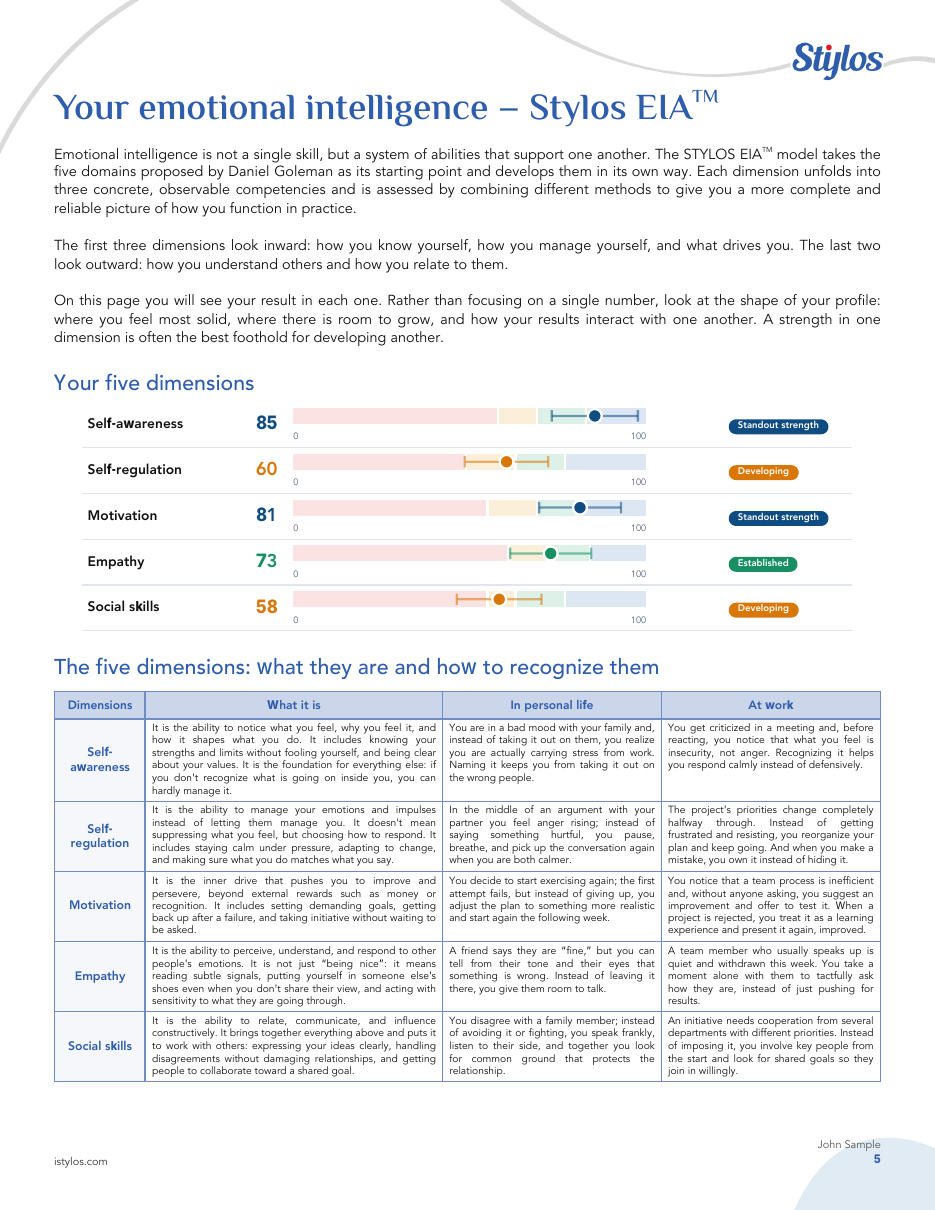
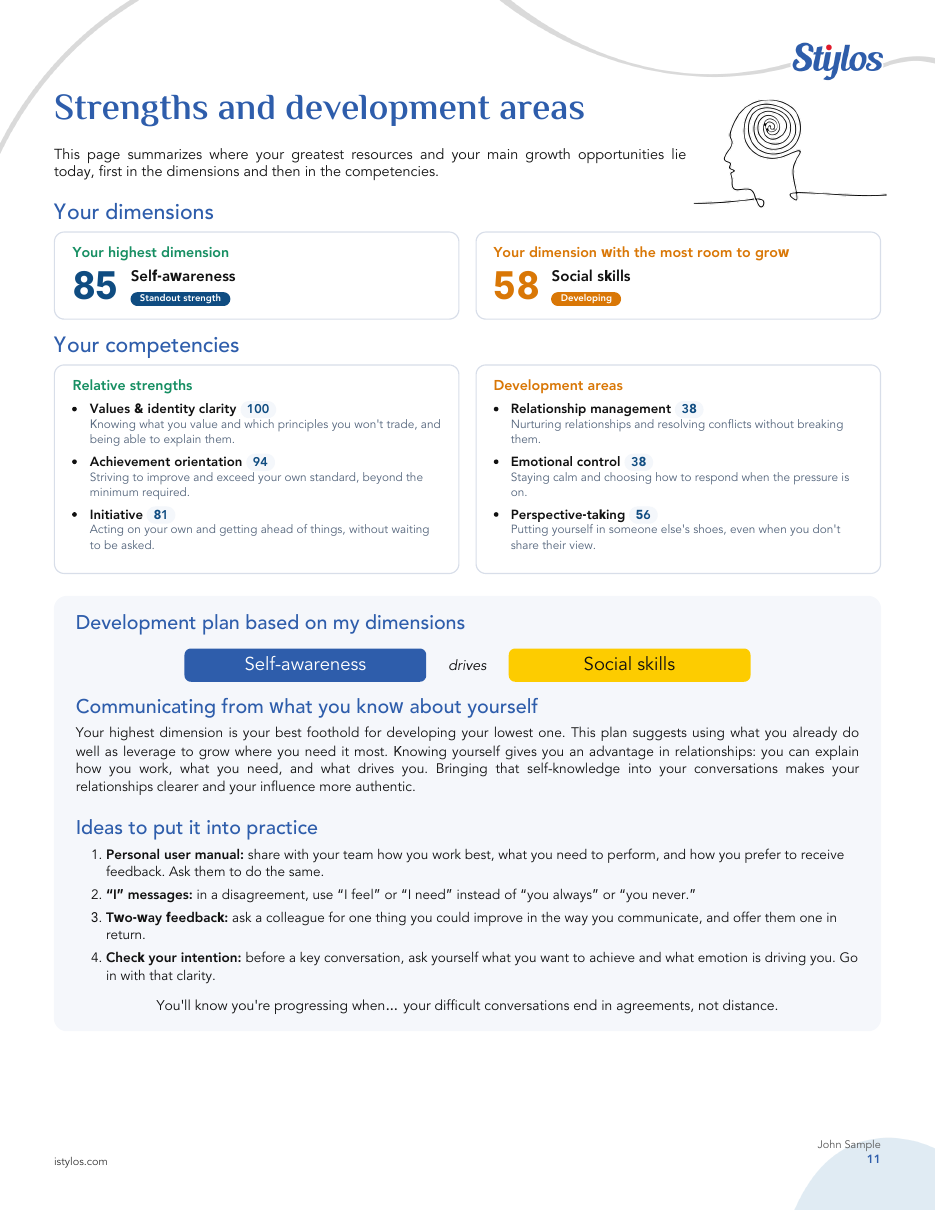
Self-awareness
85
Standout strength

The science behind it

Emotions aren't noise. They're information.

For decades, success was attributed almost entirely to rational intelligence. Research showed there is another intelligence — one that perceives, understands and manages emotions — with a decisive influence on how we live, lead and relate to others.

The amygdala hijack — and how to train it

Under threat, the brain's alarm center can fire before the reflective part steps in. The good news: this circuit is trainable. Putting an emotion into words activates the prefrontal cortex and calms the alarm.

Amygdala
Reacts first: fight, flight, freeze
⟶
Prefrontal cortex
Names it, reasons, chooses a response
1980
Robert Plutchik proposes the wheel of emotions: eight basic emotions with intensities, opposites and combinations.
1990
Peter Salovey and John Mayer define emotional intelligence as the ability to perceive, understand and manage emotions — our own and others'.
1995
Daniel Goleman brings the concept to a wide audience and organizes it into five domains: the foundation of the Stylos EIA™ model.
2007
Matthew Lieberman's neuroimaging work at UCLA shows that naming what we feel calms the emotional brain.
2021
Brené Brown maps 87 human emotions and experiences in Atlas of the Heart, building on Lisa Feldman Barrett's idea of emotional granularity.
2026
Stylos EIA™ integrates these perspectives into a practical assessment: 5 dimensions, 15 observable competencies, 3 complementary methods.
Explore it yourself

Emotions have a shape.

Every Stylos EIA™ report opens with Plutchik's wheel — a map to recognize what you feel with precision. Tap an emotion to see its intensities, its opposite and the message it carries.

↑ Tap any petal

Basic emotion
Joy

Emotions have intensity Emotions have opposites Emotions combine

Emotional granularity

The power of naming what you feel.

Most people reduce their whole emotional life to three words: happy, sad, angry. That poverty of language leaves us blind to ourselves. The richer our emotional vocabulary, the more options we have to respond instead of react.

87emotions and experiences mapped by Brené Brown — most of us use only three.

The Stylos EIA™ model

Five dimensions. Fifteen competencies.

Emotional intelligence is not a single skill, but a system of abilities that support one another. The first three dimensions look inward; the last two look outward. Each one unfolds into three concrete, observable competencies.

↙ Looking inward
Looking outward ↘

What makes it different

Not just how you see yourself. How you actually respond.

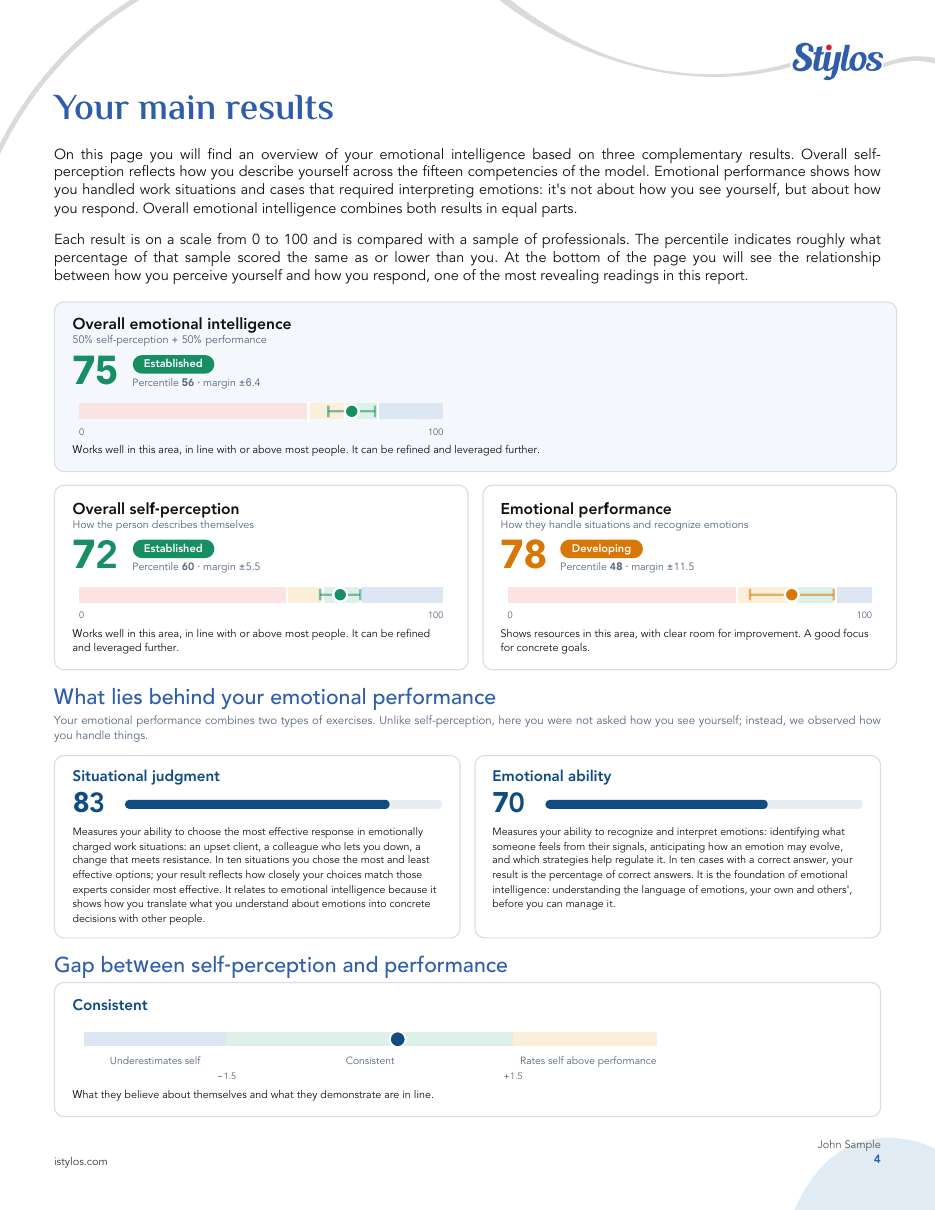
Most emotional intelligence tests rely only on self-report. Stylos EIA™ combines three complementary methods, scores each from 0 to 100, and compares results against a sample of professionals — with percentile and margin of error.

🪞
Self-perception
How the person describes themselves across the 15 competencies of the model.
+
🎯
Emotional performance
What they do, not what they say they do:
Situational judgment10 charged work situations
Emotional ability10 cases with a correct answer
=
✦
Overall emotional intelligence
50% self-perception + 50% performance
Sample profile · five dimensions
0 — 100
Priority development area Developing Established Standout strength
The most revealing reading

The gap between self-perception and performance shows whether people see themselves as they really are — a powerful conversation starter for any coach or leader.

Underestimates selfConsistentRates self above

Inside the report

12 pages that turn insight into action.

Read with curiosity, not judgment: each result is a starting point, not a verdict. Click any page to zoom in.

Main results
Five dimensions
Competencies
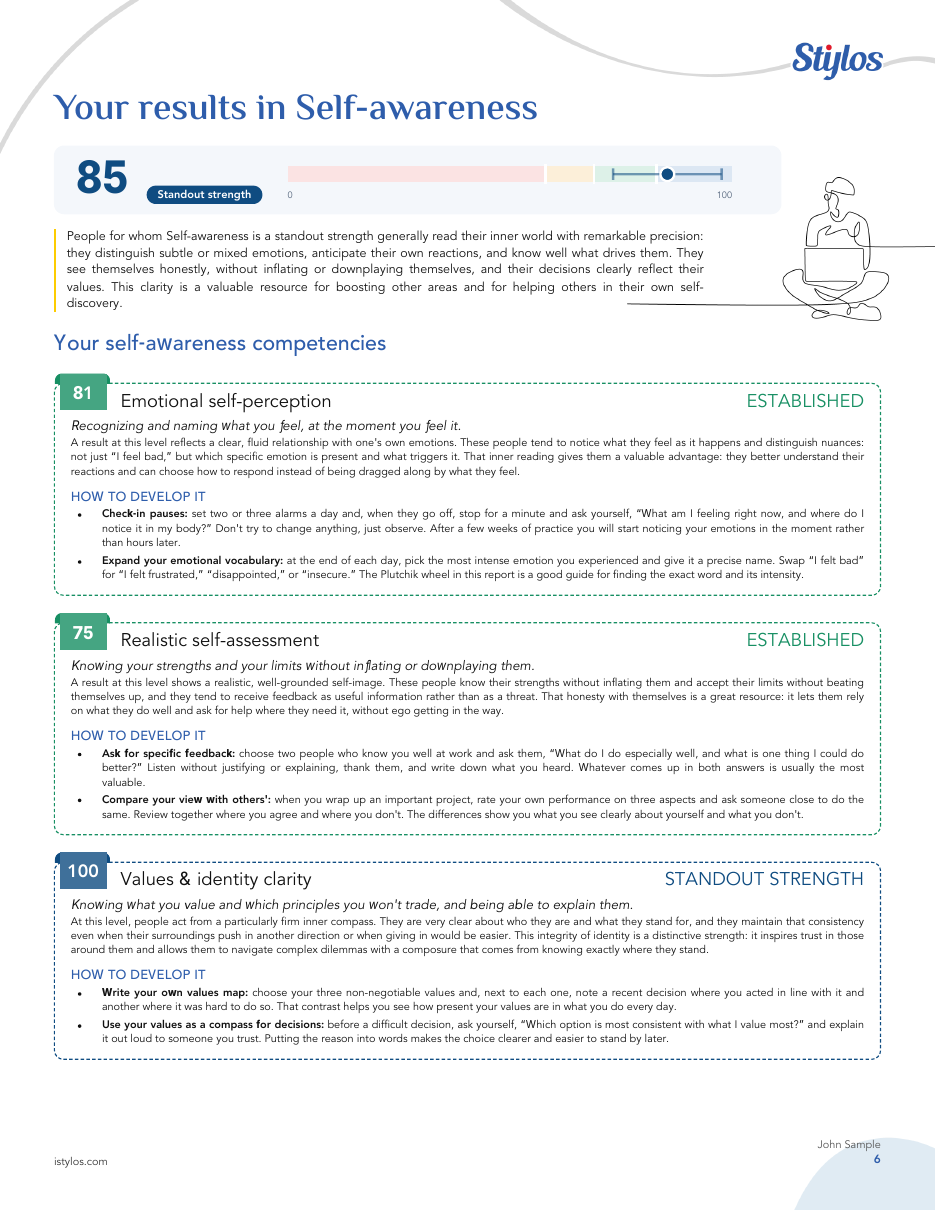
Strengths and development plan
01
The map of your emotions
The science of emotional intelligence, the brain, Plutchik's wheel and why self-knowledge comes first.
02
Your main results
Overall EI, self-perception and performance — with percentile, margin of error and the self-perception gap.
03
Your five dimensions
The shape of your profile, plus what each dimension looks like in personal life and at work.
04
15 competencies, explained
A score, a level and two concrete "how to develop it" practices for every competency.
05
Strengths & development areas
Your top three competencies, your three biggest growth opportunities and a plan where your highest dimension drives your lowest.
06
My action plan
Focus, leverage, actions, first step in 48 hours and 30 / 60 / 90-day reviews — on a single page.

Built for development

Your strength is your best foothold.

Instead of a list of weaknesses, Stylos EIA™ uses what someone already does well as leverage to grow where they need it most.

Self-awarenessdrivesSocial skills

You'll know you're progressing when… your difficult conversations end in agreements, not distance.

48h
First stepOne concrete action to start immediately.
30
First reviewCheck what worked and adjust the plan.
60
ConsolidateTurn practices into habits with support.
90
Measure progressCompare against the starting point and set the next focus.

Better together

DISC + Emotional Intelligence: the complete picture.

Stylos DISC
How do I behave?

Reveals natural behavioral style — how someone communicates, decides, sells and leads. Your preferences and tendencies.

+
Stylos EIA™
How do I manage what I feel?

Reveals how someone recognizes, regulates and uses emotions — in themselves and with others. Abilities that can be developed.

Style tells you who you are. Emotional intelligence tells you how well you use it.

Who it's for

For people who develop people.

🏅
Leadership programs
Give leaders a clear view of how they manage pressure, influence and relationships.
🧭
Coaching
Start sessions with real data and a ready-made development plan.
👥
HR & talent
Strengthen selection, high-potential and succession programs with emotional competencies.
💬
Sales & service teams
Develop empathy, self-control and relationship management where clients feel it most.

Bring emotional intelligence to your next program.

Available in English, Spanish and Portuguese for HR consultants, coaches and organizations across the USA, Spain and Latin America.

Request a demo → Explore all reports